
Related pages
Search our site for

First trimester
Key facts
What is the first trimester?
A full-term pregnancy lasts around 9 months. Most people will break this time up into 3 'trimesters' of around 3 months each.
- first trimester
- second trimester
- third trimester
Trimesters are a helpful way to think about pregnancy.
The first trimester of pregnancy is counted from the first day of your last period through to week 12. This is because when you conceive naturally, you often won't know the date of conception.
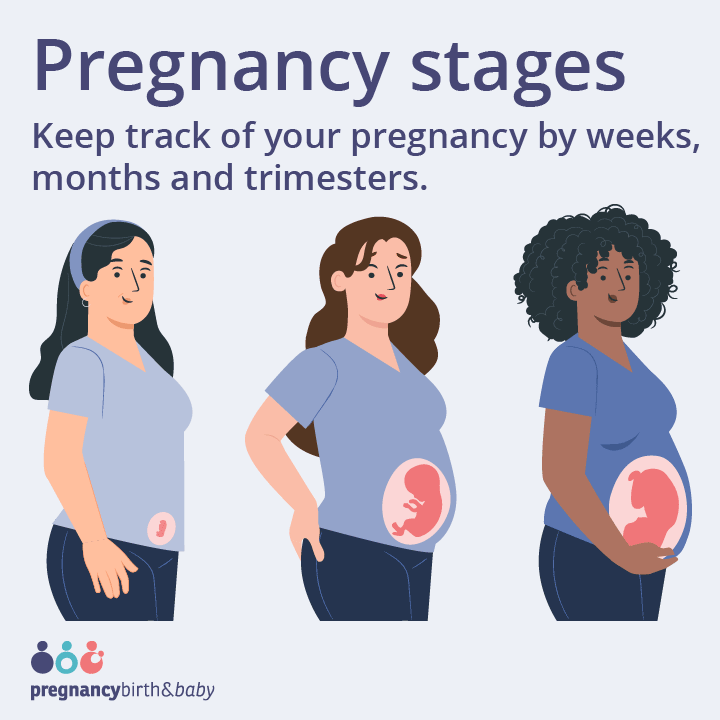
Easy to follow guide on the stages of pregnancy.
What happens to my body in the first trimester?
You might have nausea during the first trimester, but remember that every pregnancy is different. This is often called 'morning sickness', although it can occur at any time of day.
If you have severe nausea and vomiting, you should speak with your midwife or doctor. This can be a sign of hyperemesis gravidarum.
You may have:
- food cravings
- food aversions
- no change in appetite at all
Other changes in your first trimester are your breasts becoming tender, larger and heavier.
Your uterus will grow and put pressure on your bladder. You need to urinate (wee) more often.
What happens to my emotions in the first trimester?
You might feel a mix of emotions during your first trimester. Hormone changes may make you feel moody or irritable, and tiredness is common in the early months.
These feelings are normal. It can help to talk about how you feel with you partner or with a close friend.
If you feel very down or anxious, speak with your doctor or midwife. This can be a sign of antenatal depression or anxiety.
It's important to get help and the right treatment.
An untreated mental illness can lead to negative impacts for both you and your baby.
What happens to my baby in the first trimester?
During the first trimester, your baby becomes a fetus with a heart that starts to beat.
Your baby's brain, stomach and intestines are growing. Your baby has little bumps known as 'limb buds' where their arms and legs are starting to form.
What are my choices for pregnancy care and birth?
You have many different choices for pregnancy care and where to give birth.
Your pregnancy and birth care should consider your needs and wishes.
What can I expect from my doctor or midwife?
Your antenatal (pregnancy) health checks might be a:
- midwife
- GP
- obstetrician
- a combination of these people
This depends on the choices you make and where you will give birth.
Your first antenatal appointment will probably be with your doctor. They will confirm your pregnancy with a urine or blood test. These are more reliable than home pregnancy tests.
Once your pregnancy is confirmed, you can either continue to see your doctor, or you can start seeing a midwife at the hospital or birthing centre where you choose to have your baby.
In the first trimester, antenatal check-ups usually happen every 4 to 6 weeks. This can vary, based on your health and how your baby grows.
Your midwife or doctor will usually offer you an ultrasound scan towards the end of the first trimester. You might hear your baby's heartbeat at this scan.
The ultrasound will also show if you are having a multiple birth . It can also:
- help work out your baby's size
- help work out your due date
- check for some health conditions
Other health checks you may have during the first trimester are:
- urine tests to check for urinary tract infections
- blood tests to check:
- your blood type (particularly Rhesus status)
- your iron levels
- your blood sugar level (for gestational diabetes)
- for rubella (German measles) immunity
- for other infections such as HIV, hepatitis B, hepatitis C and syphilis
- cervical screening test
- conditions that if left untreated can trigger preterm labour
Your doctor or midwife will also check your general health and wellbeing.
They may ask if you have any concerns about your pregnancy.
They will also ask about medicines that you take to check their safety during pregnancy. This includes natural or alternative medicinesnatural and alternative medicines.
What is the first trimester genetic screening test?
There are different ways to screen for common chromosomal conditions in early pregnancy, including the combined first trimester screen (CFTS) and non-invasive prenatal testing (NIPT).
These tests assess risk in different ways and are sometimes used alongside other aspects of first trimester care. Your healthcare provider can help you decide which approach, or combination of approaches, is most appropriate for your situation.
Combined first trimester screen
Your midwife or doctor will also talk with you the combined first trimester screen. This screening test will check if your baby has an increased chance of having certain genetic conditions.
The screening test involves a blood test and an ultrasound. It is your choice whether you have these tests.
The blood test checks for 2 different hormones (beta hCG and PAPP-A).
The ultrasound measures the thickness of the fluid in the area behind your baby's neck. This is known as the nuchal translucency.
This area may be larger in babies with certain genetic conditions.
A computer program works out the chance of your baby having a genetic condition using:
- these results
- your age
- your weight
- how many weeks pregnant you are
- your ethnicity
- your smoking status
- whether you have diabetes
Non-invasive prenatal testing (NIPT)
Another genetic screening test you may choose to do in the first trimester is non-invasive prenatal testing (NIPT).
This is a blood test that can be done from 10 weeks of pregnancy.
During pregnancy, some of your baby's DNA (genetic material) from the placenta crosses into your blood stream. NIPT looks at this DNA to see if your baby has an increased chance of having certain genetic conditions.
If you decide to have an NIPT, your doctor will also recommend that you have a structural scan between 12 to 16 weeks of pregnancy.
NIPT is a more accurate screening test than the combined first trimester screen. NIPT is not covered by Medicare. Make sure you ask how much the NIPT will cost.
How can I stay healthy through the first trimester?
Staying healthy is especially important during pregnancy. If you or your partner smoke or vape, this is a great time to quit. Speak with your midwife, doctor or pharmacist for support.
Try to eat a variety of nutritious foods during pregnancy. This will help meet the nutritional needs of you and your baby.
It's safest not to drink any alcohol while you are pregnant. Even low-level drinking, especially in the first trimester of pregnancy, may cause fetal alcohol spectrum disorder (FASD).
You will need more of certain nutrients during your first trimester. You are advised to take folic acid and iodine supplements in the first trimester. It's difficult to get enough of these key nutrients from food.
It's important to keep up regular physical activity during your pregnancy. This benefits both you and your baby. If you have any discomfort or complications, speak to your midwife or doctor.
When should I seek medical help?
You should get medical help if you have vaginal bleeding or abdominal (tummy) pain during the first trimester. These can be signs of problems that can happen in early pregnancy.
Bleeding or pain in early pregnancy may be caused by:
- implantation bleeding — when the fertilised egg implants into the uterus lining it can cause some cramping pain or light bleeding
- bleeding from the cervix
- miscarriage — when the pregnancy is lost before 20 weeks of pregnancy
- ectopic pregnancy — when the pregnancy takes place outside the uterus, like in the fallopian tubes
- molar pregnancy — a rare, abnormal growth of the placenta
What else should I consider in the first trimester?
Here are some more things to think about in your first trimester of pregnancy:
- Book your antenatal appointments for the whole trimester — they are important to track your health and your baby's growth.
- Get support — ask your partner, a friend, or family member to come with you to important health checks.
- Are your vaccinations up to date? The National Immunisation Program funds some vaccines if you're pregnant. Speak to your doctor or midwife for guidance.
- If you feel you are at risk of violence or you are feeling vulnerable during your pregnancy, let someone on your healthcare team know.
Resources and support
Follow your pregnancy week-by-week to find out how your baby is growing and what is happening to your body.
Look at pregnancy factsheets on the Royal Women's Hospital website
Queensland Government also have an online resource What to expect during pregnancy.
Speak to a maternal child health nurse
Call Pregnancy, Birth and Baby to speak to a maternal child health nurse on 1800 882 436 or video call. Available 7am to midnight (AET), 7 days a week.
Find out how we develop and review our content.
Last reviewed: May 2025